RESEARCH
Stapling Strategies Around the Green Line in Nicosia’s Old Town
Book chapter
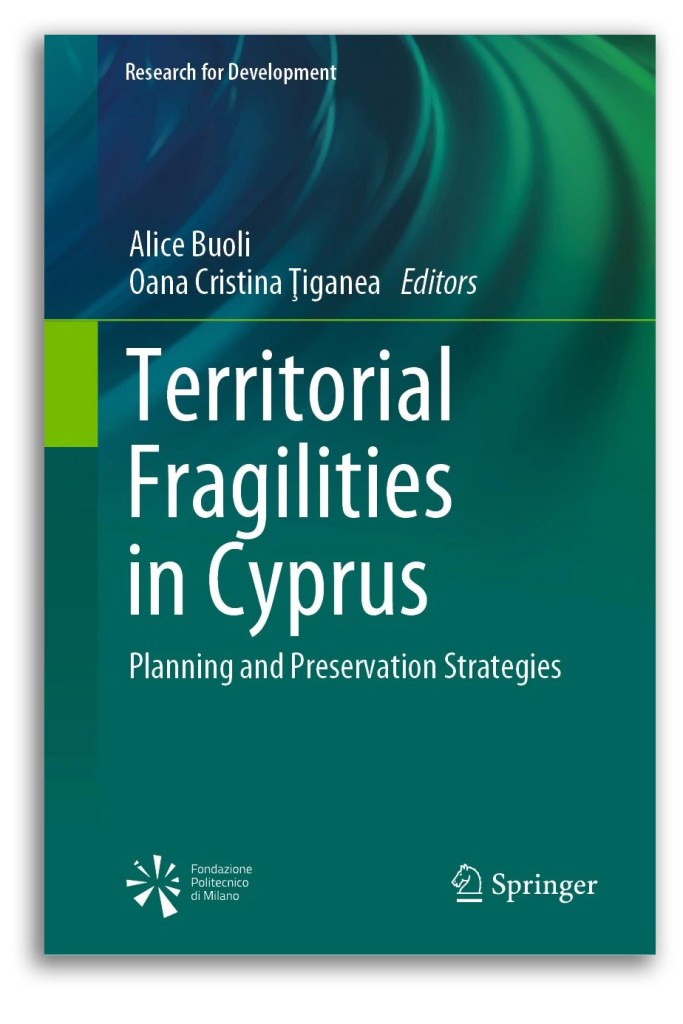
Pasta, F., Riga, D., Barbieri, F., Chen, W., Lyu, W. (2023). Stapling Strategies Around the Green Line in Nicosia’s Old Town. In Buoli, A., Ţiganea, O.C. (eds.) Territorial Fragilities in Cyprus. Planning and Preservation Strategies. pp. 105-128. Springer. https://doi.org/10.1007/978-3-031-36076-3_8
This essay outlines a theoretical and methodological framework for the proposed intervention strategies for Nicosia’s walled city center presented in this section of the volume. The goal of this process, which we refer to as “stapling”, is to contribute to creating a platform for local collaborative activities across and beyond the border as a way of tackling issues of shared identity. The chapter is divided into three parts. We begin by providing a conceptual background, relating a range of subjects that are relevant to our research and intervention approach in the divided city of Nicosia, such as, e.g., the concept of a “thick” border, the ambivalent semiotics of urban space, the gap between conceived and experienced space, the materiality of everyday life, and the idea of cross-border engagement. Grounded in the theoretical framework and based on fieldwork conducted in Nicosia, the second section identifies three main themes, which can be considered as both challenges and opportunities that the proposed strategies aim to address and develop from different perspectives. These are: (1) bridging inter-communal planning with civil society; (2) re-activating under-used or abandoned spaces; and (3) building upon a shared socio-ecological system. Such macro-subjects constitute criticalities that present the potential for action and intervention. The third section introduces the methodological approach shared by the three strategies. We briefly outline the principles of community-based action planning, the key guidelines for intervention, and the community actors to be involved. Based on these elements, we discuss how the proposed planning strategies do not constitute a prescriptive masterplan, nor an inflexible vision. Rather, they compose an open framework for strategic and concerted action. They are complementary but not necessarily interdependent. We conclude by defining a “stapling strategy” as a process that builds upon and develops existing socio-spatial interlinkages between the two sides of Nicosia’s historic city center, metaphorically “stapling” or “stitching” together spaces that used to be contiguous and continuous but are now severed by the Green Line. While grounded in the socio-political reality of Nicosia, this methodological approach can relate to other divided urban contexts.
Book
206 pages
Published by Springer, September 2023
ISBN 978-3-031-36075-6
E-ISSN 2198-7319
 Dafni Riga